Deshawn Spears was only 16 years old when he first used crack cocaine. An aspiring baseball star, the teenaged North Trenton native caved to environmental pressures and was sent on a decades-long path of addiction, homelessness, and incarceration.
Growing Up on Stuyvesant Avenue
Deshawn grew up on Stuyvesant Avenue, a well-known neighborhood in North Trenton. He lived with his mother and his older sister and attended Gregory Elementary, where Deshawn recalls that he and his sister had perfect attendance, never missing a day of school or showing up late. The Stuyvesant-Prospect neighborhood was fun for Deshawn growing up, just walking distance from Cadwalader Park, where he would often play baseball with the neighborhood kids. Even without his father in the home, Deshawn remembers his childhood being one of fulfillment.
It wasn’t until he and his family moved to the other side of the city that things became more challenging. In his early high school years, Deshawn and his family moved to East Trenton’s Miller Homes. Before it became Rush Crossing Apartments in 2014, Miller Homes was a public housing community that was infamous for poverty, crime, and drugs.
The Crack Epidemic Comes to Trenton
The crack epidemic in the inner cities of America in the 1980s is well documented, and Trenton was no different from the major cities affected by crack cocaine. An already vulnerable city was decimated by the drug, which caused a massive spike in crime, drug-related arrests, and addiction. Cities across the country were flooded with the newly discovered drug, creating an underground industry of dealers and users. Deshawn was both.
“I started in 1986 when I was 16 years old,” Deshawn said. “I was selling [crack] and so many people were coming for it. I was curious why people kept coming back for this stuff.”
Deshawn said he and his friend who dealt crack with him were talking about people’s addiction to the drug when they decided to try it themselves. “I asked him, ‘Why do people keep coming back for this? Do you want to try it?’ I wonder if he would’ve said ‘no’ would I have been in this position,” Deshawn said. That first hit sent Deshawn down a path that would take decades to climb out of.
“I couldn’t get to practice because I wanted [crack] more than I wanted baseball. And I was a young guy, I wasn’t really thinking straight or nothing like that. I just know that that’s what I wanted was the drug life,” Deshawn said. The Junior High School 3 student found himself becoming the person he used to sell drugs to: neglecting responsibilities, disregarding his goals, and fully conforming to the life of a person experiencing addiction.
Losing His Mother
Ten years into his addiction, Deshawn would experience the hardest tragedy of his life. In 1996, Deshawn’s mom suffered a severe health complication that left her brain dead. Deshawn was in jail at the time and was granted compassionate leave to visit his mother in the hospital.
“I got caught with a little bit of drugs. At the time I was in the workhouse. I was in jail and I was mad because I couldn’t see her,” Deshawn said. “They let me go to the hospital when she was on her death bed, but they said she was brain dead. She could hear me, but she couldn’t open her eyes or anything.”
The then 26-year-old found out about his mom’s death during a phone call from jail. “That phone call was devastating. I just lay in my bed all day crying. I couldn’t be there for her. It was terrible.”
The loss of his mother made his addiction worse once he got out. Deshawn admits that her death amplified his drug use, and he went in and out of recovery programs for years with no intention of staying sober. For the next 16 years, Deshawn was fully immersed in his addiction, to the point where his biggest advocate had a difficult decision to make.
The Day the Door Closed
Deshawn’s sister usually let him stay at her place from time to time, since he proved to be a good babysitter to her two kids while she was working. But his addiction had gotten to a point where she no longer felt comfortable giving him access to her kids or her home.
“My downfall was my sister. My sister always let me in the house when I needed to come in. My sister used to always say, ‘Boy, what are you doing? Get in here, wash your butt, get something to eat.’ I remember this clear as day in 2012. I was sitting in my car, and my sister was coming up. And this time, she wasn’t even looking at me. She just kept walking like she was going up in the house.”
Deshawn thought a final plea, a promise to get help for his drug use, would persuade his sister to let him in the house, but nothing would change her mind.
“I was like, ‘Sis!’ She turned around and looked at me. And I was like, ‘I’m about to go back [into a recovery program],’ and she was like, ‘Okay,’ and she walked up to her door and opened her screen door and she shut it. After that point on I said to myself, ‘No, I can’t do this,’ because now I don’t have nowhere to go,” Deshawn said.
Through the years, Deshawn had been through The Mission’s recovery program a few times, but he admits he never intended to stay clean. It wasn’t until his sister removed him from her life, 26 years into his addiction, that he finally saw that he needed to make a permanent change.
Finding His Way Home
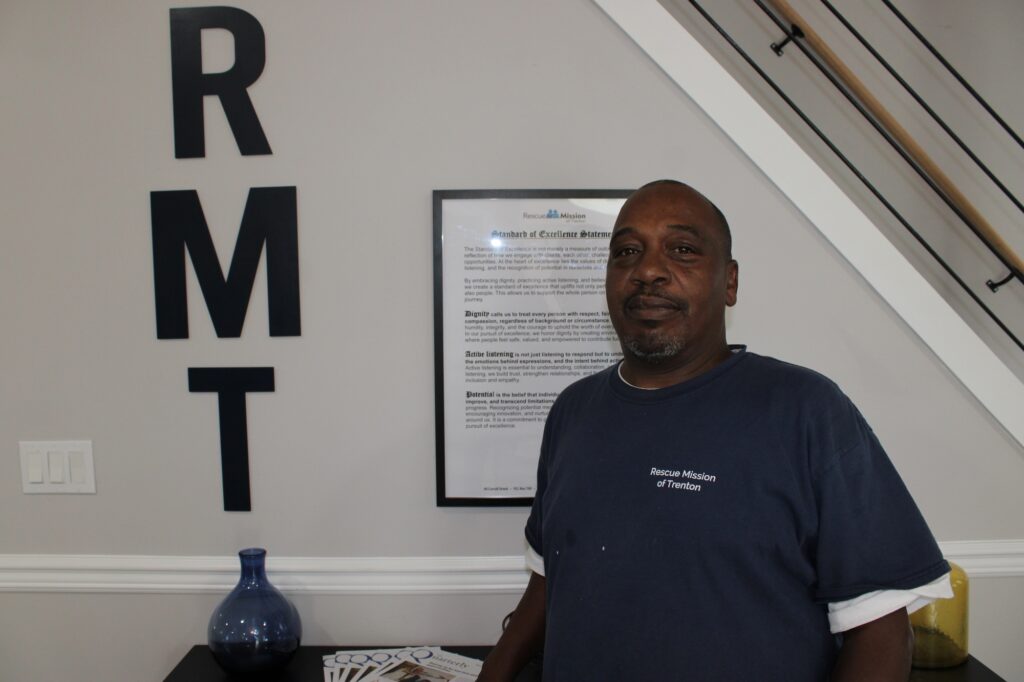
Now experiencing homelessness, Deshawn found a safe space at The Mission’s shelter. He completed his recovery program and was hired by The Mission as a peer specialist, supporting others going through the same things he had.
Today, Deshawn is the house manager of The Mission’s newest property on West State Street, just a three-minute drive from the home on Stuyvesant Avenue where his mother raised him.
“She would love me. She would love the man that I’m turning out to be.”
Deshawn said this tearfully. His mom never got to see him as a stable, sober adult. With that in mind, he wants to make sure his clients’ families don’t go through what he did.
“My goal is to try to steer them to go on the right path and stay on the right path. People talk about, ‘I want to get home to my mom, I want to get home to my sister, I want to get home to my kids. They need me.’ Yeah, they do need you out there. They really do. But you can’t worry about getting back out there to them if you can’t even get yourself right,” Deshawn said.
“It’s been 14 years [sober] for me. I had to change a lot of stuff I was doing, and the first thing was my mind. I had to change the way I was thinking, how I was moving. I knew it was all about me, nobody else.”